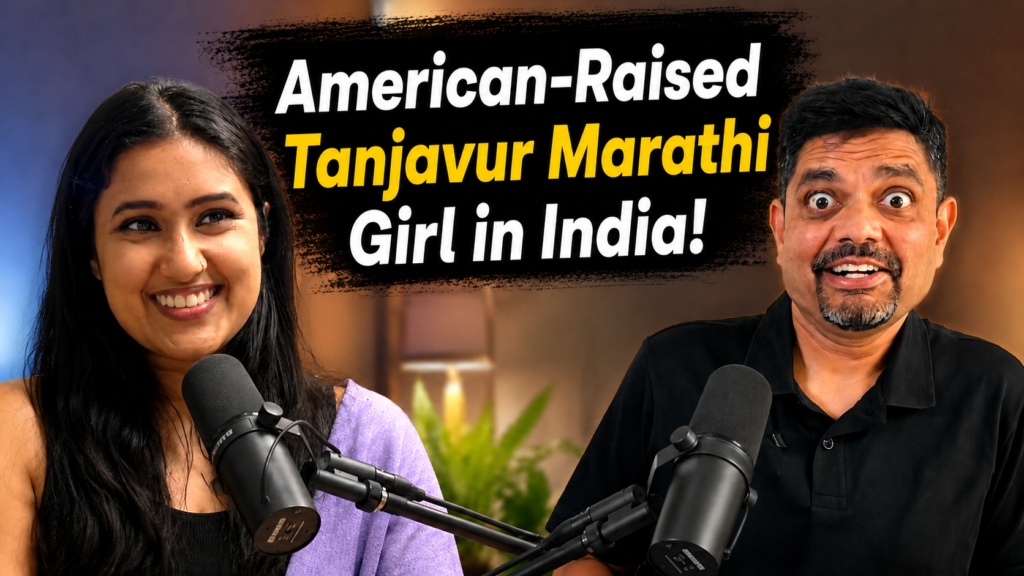
This one’s a little different. Instead of hosting, Rahul — the man behind American Bhau — sat down as the guest on Alpana Deo’s own Marathi podcast, “मनातलं आणि मनासारखं,” a show built around people who left one career for the one that actually called them. Rahul had featured Alpana on the American Bhau Podcast to talk parenting; this time the mic pointed back at him, and he told the story of walking away from a comfortable tech job in Australia to build a Marathi YouTube channel with no plan, no audience, and no guarantee any of it would work.
THE SABBATICAL THAT NEVER ENDED
Rahul was a senior director at Atlassian, the Australian software company — good pay, a manager and team he genuinely liked, an open, flat, low-corporate culture. By any normal measure, nothing was wrong. But a green card had come through in 2022, and for the first time as an immigrant, he felt like he had enough ground under him to take a real risk.
In March 2023, he asked his manager for six months off. Not a resignation — a sabbatical. The company said yes. One of his teammates made him a bet on the way out:
“Rahul, I’ll guarantee you — you’re not coming back.”
Rahul told him he would. He just needed to scratch an itch first.
That same year, his wife Pallavi and their two kids flew to India — their first trip back since COVID had kept them away for four or five years. Rahul stayed behind alone, and instead of sitting still, he did something he’d wanted to do since the day he landed in America: a solo road trip. He drove his Tesla straight from home to Vancouver, then spent five or six weeks driving the entire way back down the Pacific Coast Highway, alone, thinking.
FINDING THE FORK IN THE ROAD
Somewhere on that drive, something became clear that he calls “crystallized” — he wasn’t going back to software engineering. Not because the job was bad. He just didn’t want to be a full-time tech employee anymore. He’d always had a pull toward visual storytelling — carrying a camera to friends’ functions, filming and editing for fun — and Pallavi, an architect trained at Mumbai’s J.J. School of Art, had a creative sensibility he leaned on constantly. She is, by his account, the entire creative engine behind American Bhau, and she’s listed as co-owner, not just support.
They already had a small camping vlog running — filming road trips across America in the Tesla — but it had no traction. Rather than force that into something bigger, they went back to the drawing board and landed on an idea that felt obvious once they saw it: nobody online was showing what a normal, middle-class Marathi family’s life in America actually looked like. Most of what existed was daily-vlog content aimed at a different audience entirely. That gap became American Bhau.
FROM “HORN OKAY PLEASE” TO AMERICAN BHAU
The name took several tries to get right. Their first English-language channel was called “Horn Okay Please,” which they later learned had picked up an unrelated negative association from a controversy in India — so they renamed it “Desi Tesla Dad,” and eventually “American Bhau Travel.” For the new Marathi channel, Rahul wanted to avoid the word “katta” (a common, slightly overused choice for Marathi platforms) after a friend warned him off it. A freelance scriptwriter who worked with them at the time, a man from Parbhani everyone called Pradeep Bhau, helped brainstorm a shortlist of 10 to 20 names. “American Bhau” landed near the top — but Rahul is candid that they weren’t sold on it at first.
“We were not really sold onto it, like… we were like, American Bhau, okay, that’s fine. But now, looking back, that has turned out to be such an amazing brand builder.”
The word “bhau” carries a warmth in Maharashtra that a more polished brand name couldn’t replicate — the same casual familiarity as calling someone tai or mavshi. It also came with a built-in origin story about why he doubted his own Marathi in the first place.
BETTING ON “IMPURE” MARATHI
Rahul’s father worked for the central government, which meant the family relocated every three years or so throughout his childhood — Gujarat, Dhule, Jalna, Aurangabad, Latur, moving between Marathi, English, and Gujarati-medium schools along the way. What came out of that, by his own description, is a “khichdi” Marathi — not the polished Puneri dialect, still mixing up small grammar points people online love to correct him on. He gets trolled for it regularly. At some point, he stopped caring, and then realized the accent itself was the asset, not the liability.
Before American Bhau, they’d tried English and Hindi content and gotten nowhere close to the same response. Two established Marathi YouTube creators, a husband-and-wife team from Pune named Sukirti and Urmila Nimbalkar, gave them the nudge that changed the direction: Sukirti told Rahul his editing and production were technically solid, but he was making content in the wrong language. The response after the switch to Marathi was immediate.
His read on why: trust, more than views or followers, is the actual currency of social media, and trust builds fastest in someone’s mother tongue. He and Alpana joked about how a five-minute conversation in Marathi turns unguarded and easy in a way English or Hindi never quite does — there’s always a small, artificial gap when you’re not speaking the language you think in.
He’s also unusually relaxed about negative comments, treating them as a signal rather than a threat — engagement is engagement, and he’ll sometimes bait a critical commenter into a longer exchange just to keep the conversation going. His name for the content algorithm that demands to be constantly fed across all seven platforms they post to daily:
“बकासूर” — Bakasur, the mythological demon who has to be fed nonstop, or he forgets you exist.
His broader philosophy on staying in front of a camera for a living: don’t perform a version of yourself you can’t sustain.
“I’m a village guy, I come from a farming family, and that’s my Marathi, and that’s who I am. The more you try to fake it, the harder it gets to sustain long term.”
WHAT THE CAMERA TAUGHT HIM
Rahul used to believe he simply wasn’t a people person — more comfortable being handed a hard technical problem, disappearing to solve it alone, and coming back with an answer. Running American Bhau undid that idea completely; he now leads, collaborates, and works to inspire an audience daily, and says the shift in how he sees himself has been one of the bigger surprises of the whole journey.
The other unexpected payoff was his marriage. Working alongside Pallavi as true co-owners — not in the more traditional roles either of their families might have expected — gave him a new appreciation for her people-management and creative instincts, seen in a completely different light than before.
His engineering background, meanwhile, turned out to be direct professional leverage rather than something he left behind. Reading analytics, iterating on what the data says is working, treating the audience response like a product feedback loop — it’s the same muscle he used as a software engineer, just pointed at a different kind of product. He even built an internal “Mission Control” tool that surfaces daily reminders on what to post where, cutting down the mental overhead of running content across seven platforms at once.
On fear, which he says never fully goes away, he has one rule: set the emotion aside and look at the hard numbers instead.
“I might be down 200, 300k, right — that would be my loss, but I can always go back.”
He ran that exact math before he quit — worst case, a few years and a real financial loss, but a return to a 9-to-5 was always on the table. What wasn’t recoverable, he decided, was looking back at 70 or 80 and wondering why he never tried. When imposter syndrome shows up now, his fix is rereading audience comments, emails, and testimonials until the noise settles.
RAPID FIRE
Alpana closed the episode with a quickfire round:
– Stability or freedom? Freedom.
– Logic or intuition? Leans logic.
– Silence or words? Words.
– America or Maharashtra? Maharashtra.
– Script or spontaneity? Spontaneity.
– One Marathi word to describe yourself? “Zingaat.”
– Does fear teach more, or failure? Failure.
– What would you tell yourself 10 years ago? “Start YouTube earlier.”
Bringing you stories of grit, innovation, and success from the global Indian community.