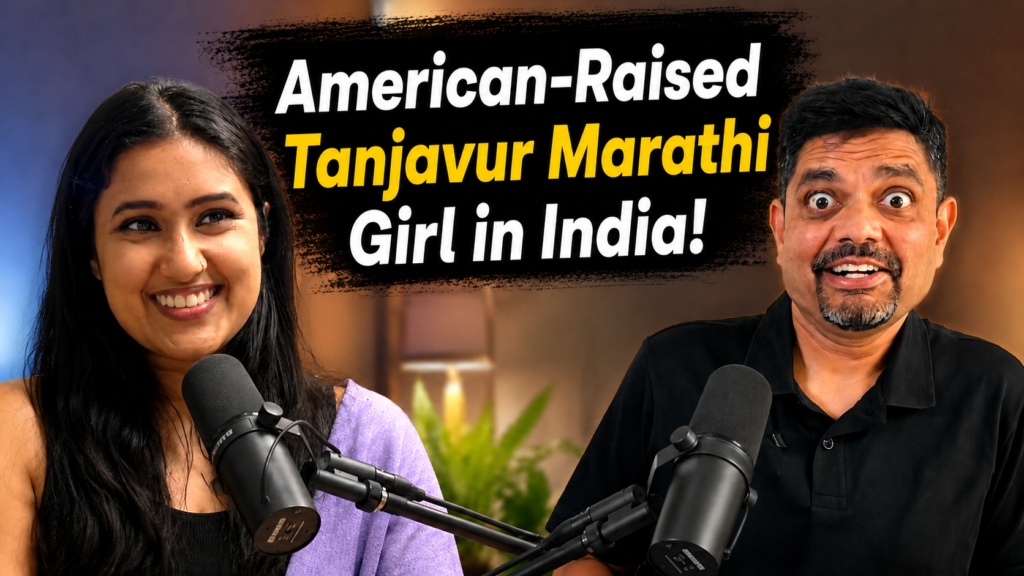
In our latest episode of the American Bhau Podcast, we sat down with Alpana Deo — a certified Parent & Kids Life Coach, host of the Marathi podcast “मनातलं आणि मनासारखं,” and founder of Mothers Gurukul — to talk about the one investment every parent makes without ever writing a business plan for it: raising their kids. Alpana has spent close to 14 years helping Marathi and Indian families navigate parenting in America, and this conversation covers everything from screen-time battles to the exact question she asks herself when she doesn’t know if a family needs help.
COACHING IS NOT COUNSELING
Alpana opened by clearing up the confusion she runs into constantly: people hear “parent coach” and assume it’s a softer word for therapy. It isn’t. She draws the line with a sports analogy — a coach works toward a specific goal, and once that goal is met, they move to the next one. Counseling, by contrast, usually starts by digging into what already happened.
“It’s very much goal oriented. It focuses on your present and prepares you for your future.”
Her end goal with every client is to work herself out of a job. Sessions build toward independence, not dependency — she wants people so equipped that they can, in her words, coach themselves once the sessions end. And she plays both sides of the table: she works with the parents and the kids, sometimes in the same family, which is part of what makes her practice distinct from a typical child therapist’s.
FROM AN IIT CAMPUS IN KANPUR TO MOTHER’S GURUKUL
Alpana’s own path to this work started somewhere unexpected. She grew up on the IIT Kanpur campus — her grandfather was part of the founding generation of professors, recruited into the project through a Mumbai connection. Her father is from Pune, her mother from Amravati, and despite growing up far from Maharashtra, her grandparents enforced one uncompromising house rule: Marathi only, spoken at home, with no formal Marathi schooling available anywhere nearby.
She came to the US on an H4 visa after marrying her husband Himanshu, who was already a graduate student here. With an MBA in marketing and finance and no work authorization, she started small — writing a parenting column called “Mother Tongue: Blessing for Indian Kids” for a South Asian community newsletter, and informally coaching friends for free during the years she lived in Austin and later Houston. The business didn’t become official until she received her EAD after COVID, and Mothers Gurukul was born from over a decade of unpaid groundwork.
THE TUG-OF-WAR COVID LEFT BEHIND
Ask Alpana what changed in parenting over the last few years and she doesn’t hesitate: everything, starting with screens. COVID didn’t just increase screen time — for nuclear families without grandparents around to buffer the exposure, it made screens the default coping mechanism for stressed-out parents and bored, isolated kids.
Her approach to fixing it isn’t a stricter rule. She described working with a middle-schooler who already knew, on his own, that he couldn’t control his phone use — the problem wasn’t awareness, it was follow-through. Instead of imposing a timer from above, Alpana had him keep a self-audit diary: log how much time he spent on each app, log every time he felt the urge to check his phone. She calls it a mirror, not a punishment. She uses an old architectural idea to frame it for parents — the “उंबरठा,” the physical threshold that marked the boundary of a traditional Indian home — as a way of thinking about the boundaries families need to rebuild deliberately, together, rather than enforce one-sidedly.
Her own family rule: phones charge overnight in a separate room, with only one phone kept nearby in case of a family emergency across time zones in India. Notifications off. And she doesn’t exempt herself from the problem either.
“That’s not me time, that’s algorithm time. Algorithm is taking that time, your time.”
On the harder question — whether platforms or governments should just ban social media for kids outright, as Australia has done for under-16s — Alpana disagrees. Kids are resourceful enough to get around a ban, she argues, whether through a friend’s account or a fake birthdate. She’d rather see parents lean on built-in parental controls, the way they already do with Netflix, paired with open conversation. Her sharper warning was about something newer: AI chatbots quietly becoming a stand-in friend for kids who don’t feel like they can talk to their parents. Whatever the tool, she said, parents have to stay the first point of contact — not the last one.
“MY MOM LOVES ME MORE WHEN I SCORE 100”
Alpana runs group coaching sessions for roughly 20 kids between ages 5 and 9, and one story from those classes stuck with her. In a session with a third grader, she asked what made a “good” day versus a “bad” day. The child’s answer, almost automatic: scoring 100 meant her mom would be happy. Scoring 80 meant she was bad.
“My mom loves me more” — a child, describing what a top score meant to her, in one of Alpana’s coaching sessions.
She’s watched this play out from the parent side too — at her own son’s 4th-grade award ceremony, listening to an endless list of other kids’ extracurricular achievements read out loud. In her group classes, she sometimes lets the kids sit quietly for the last ten minutes of a session, no activity, no structure. One parent saw her child resting like that and assumed something was wrong — that the child had fallen asleep in class. Alpana calls that reaction sad, not because the parent is a bad parent, but because it shows how little unstructured downtime desi and Asian kids are expected to have at all.
Her read on why this pattern persists: for her parents’ generation in India, academic competition really was the only path out and up. That math doesn’t translate cleanly onto kids growing up in the US, especially now that traditional academic credentials matter less “in the age of AI” than they once did — a shift most parents haven’t caught up to yet.
ONE SPORT, ONE CALM THING
Alpana’s own rule for her kids is simple: academics, plus one physical activity, plus something calming. Her daughter plays competitive cricket as a leg-spinner for a girls’ team in Sugar Land, Texas, and has made it to regionals. Her son plays golf. The calming half of the equation doesn’t need to be ambitious — she tells parents you don’t need a child who sings like Kishore Kumar, just one who hums.
What she pushes back on is overload — the parent who signs their kid up for five activities at once and ends up spending their own life as a full-time driver between them, with no social life of their own left over. She points to a pattern she’s noticed in American families: one sport per season, not everything running year-round simultaneously. The families who stick with a smaller number of activities consistently, she’s found, end up with real bonding rituals — not just a packed calendar.
WHEN TO ASK FOR HELP
Toward the end of the conversation, Alpana laid out the questions she actually uses to tell whether a family needs outside support. The core one: am I emotionally available enough that my child would bring me anything — happy or scary — without fear of being judged? If a normal conversation at the dinner table keeps sliding into conflict, if a kid seems to be interpreting conflicting signals from each parent, or if a child would rather be anywhere but home, something in the pattern is missing — even if nothing dramatic has happened yet.
Her closing message was aimed directly at the guilt many parents carry about needing help in the first place:
“I am going to become a better parent” — not a lesser one, Alpana said, describing what seeking coaching actually does for a parent.
Her last piece of advice, delivered simply and without qualification, was about comparison — between siblings, between a child and the neighbor’s kid, the “सोम्या गोम्या” reflex so many desi households fall into without noticing:
“Comparison is a thief of joy. Never.”
You can find Alpana Deo on Instagram and at mothersgurukul.com.
Bringing you stories of grit, innovation, and success from the global Indian community.