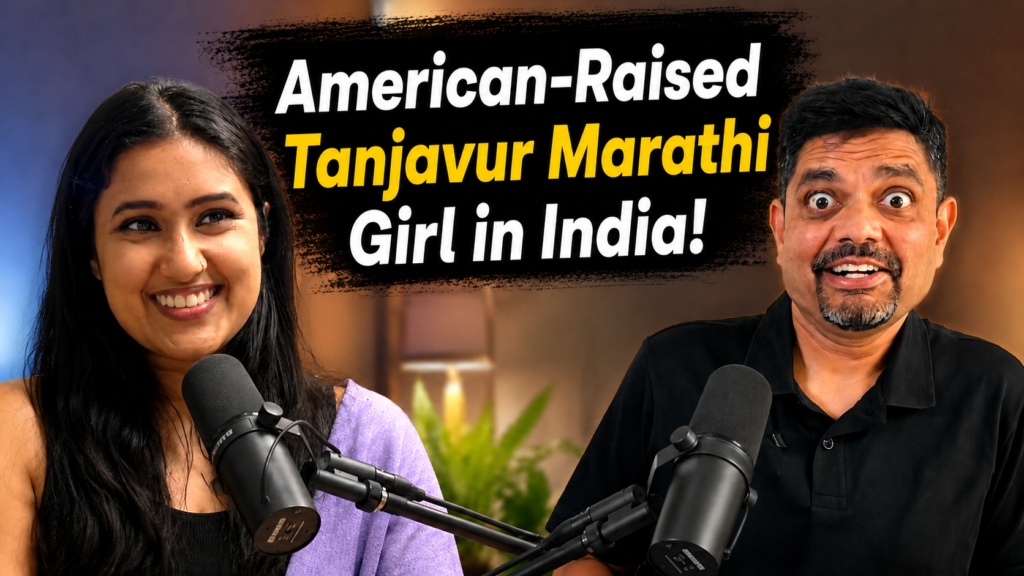
In our latest episode of the American Bhau Podcast, we caught Nisha Dandekar live from the middle of the ocean — literally sailing between New Orleans and Mexico, four hours out of port, talking to us over satellite internet. Nisha is an Electrotechnical Officer, or ETO, on a cruise ship in America, and she runs a YouTube channel called Lady ETO onBoard that shows people exactly what that job looks like. Marathi girls in electrical and mechanical engineering rarely end up here. Nisha’s story explains why that’s starting to change.
THE JOB NOBODY EXPLAINS
An ETO keeps a ship’s entire electrical system running — everything from cabin lights to sewage treatment to the massive compressors that heat and cool a vessel carrying thousands of passengers. Nisha put it simply: think of Maharashtra’s state electricity board, except she is the electricity board, and there’s no outside grid to fall back on. A ship generates every watt it uses.
On her current cruise ship, that means six diesel generators feeding roughly 4,000 to 5,000 cabins, plus the satellite systems that let 3,000 passengers stream video from open ocean. The ship switches fuel types depending on where it sails — diesel near the US coast to meet stricter emissions rules, heavier fuel oil once it’s back in international waters — and every reading from every sensor gets logged. Nothing can be faked or fudged; port inspectors pull the logs.
Some of what she described sounds more like a small floating city than a workplace. The ship has its own hospital. Its own morgue. And, for anyone who loses control of themselves mid-voyage, its own holding cell, monitored by onboard security.
FOUR REJECTIONS BEFORE THE FIFTH INTERVIEW SAID YES
Nisha grew up near the water in a fishing community in Mumbai, but nothing about her childhood pointed toward a life at sea. She studied electrical engineering — first a diploma straight after 10th grade, then a full bachelor’s degree — mostly because job opportunities for women in electrical and mechanical fields on land were thin, with most female engineers routed into office roles rather than technical ones.
The maritime path opened up almost by accident. The man who is now her husband was researching how to break into the field, and Nisha, holding the same qualifications, started researching alongside him. She managed to find exactly one woman already working as an ETO to talk to — and even that single contact told her plainly that it wasn’t easy.
It wasn’t. Nisha failed her first four interviews.
“Nobody was there to guide us. We kept giving interviews, kept failing, studied again, gave interviews again.”
Between attempts she taught herself from YouTube videos and textbooks, treating every rejection as a data point on exactly where her knowledge was thin. On the fifth interview, she passed — closing out a job search that had taken a full year after graduation.
CARGO VS. CRUISE: A COMPLETELY DIFFERENT KIND OF PRESSURE
Before cruise ships, Nisha spent five years in the merchant navy on cargo vessels, and she’s candid that it’s a different world entirely. On a cargo ship, there is exactly one electrical officer. If something breaks, there is no backup opinion, no second-in-command to check her work — the entire vessel’s electrical system depends on one person, full stop.
Some cargo is more forgiving than others. Nisha explained that LNG carriers — ships hauling liquefied natural gas at temperatures around minus 100 to minus 160 degrees — pay noticeably more than cruise work specifically because the risk is higher: a single spark near the cargo can be catastrophic, so these ships dock far from populated areas and crew rarely get shore leave at all.
Cruise ships flipped the equation for her. Instead of one electrical officer, she now works alongside three or four others and a team of roughly 100 across the wider engineering department, with senior officers absorbing most of the high-stakes decision-making. The trade-off she’s found genuinely surprising:
“The work-life balance here is better.”
She’s currently the only woman in her ship’s electrical department, though she’s begun to see more women coming up through the junior ranks — she knows of two other Indian women currently in the field.
SIX MONTHS AT SEA
A typical day starts before 6 a.m.: stretching, breakfast by 7, a 10-minute toolbox meeting at 7:30 where the day’s jobs get assigned, then work through to an 11:30 lunch, a mid-afternoon coffee break, and a shift that runs until 6 p.m. — unless there’s an emergency, in which case maritime labor law caps her at 14 hours with a mandatory 10-hour rest period. A company phone stays with her at all times, even in the shower, because missing an emergency call earns a formal warning.
Cruise contracts run four months at sea, followed by two to two-and-a-half months home — longer than she’d like, since her husband works on a different ship line entirely (Royal Caribbean’s TUI Cruises, based mostly in Europe), and their schedules rarely line up. The one time she saw his ship in person, she was riding along as a passenger, and even then he was too busy working to join her ashore.
The hardest stretch of her career, by her own account, wasn’t a storm or an emergency — it was her very first assignment, a 25-day nonstop crossing from Singapore to Europe with zero port stops, as the only woman among 25 crew members, brand new to ship life.
“I was emotionally weak the entire time. I was scared — who do I even tell? What do I even say?”
Storms took longer to stop scaring her. Her fix, once seasickness and fear of accidents crept in after watching too many ship-disaster videos online, came from her father: stop watching the videos, focus on the training and the ticket already in her hand. Practical tricks helped too — sleeping diagonally across the bed instead of straight, so the ship’s motion registers less, and earplugs to block the sound of things shifting in rough seas. Now, she says, a rolling ship doesn’t register at all.
REAL TALK ON SAFETY AND THE SOCIAL MEDIA HIGHLIGHT REEL
Nisha pushed back directly on the polished image cruise life gets online. The crisp white-and-black officer’s uniform people picture, she said, describing her own daily coveralls on camera, isn’t what most of the job looks like day to day — for months at a stretch, hands stay stained with grease and carbon. There are no weekends on a cruise ship; every day is a working day, unlike some cargo assignments. Port stops depend entirely on operational need, not entitlement, and she’s blunt with newcomers who join expecting a travel perk: if sightseeing is the priority, the hotel department — not engineering — is the better fit, with different hours and lower pay to match.
On safety specifically, for a woman working in an overwhelmingly male field, her read runs counter to the instinct most parents have:
“Nowhere in the world is safety guaranteed for girls. But here, everything is on camera, and if a harassment complaint is filed, there’s an investigation — and the person can be fired. A harassment stamp follows you on your CDC. No other company will hire you after that. Can you say that happens every time on land?”
Because the maritime industry is small and every seafarer’s document trail is permanent, she argued, professionalism gets enforced in a way it often isn’t on shore — people protect a career they’ve spent years and lakhs of rupees building.
ADVICE FOR THE NEXT GIRL CONSIDERING THIS
Nisha’s channel started by accident. Crew on different ships used to message each other for help troubleshooting equipment, so she began uploading videos — crane systems, generator issues — so anyone could find the answer without waiting on a friend. Her own instructors eventually started showing her videos to new students. Her Instagram content has since shifted toward the everyday, lifestyle side of the job for people who’ve never set foot on a ship — deliberately different from her husband’s Instagram page, which she points people to for the technical how-to-break-in information so she doesn’t have to repeat it.
For parents hesitant to let a daughter pursue this field, her advice is direct: the job isn’t gendered.
“This job doesn’t have a male engineer or a female engineer. It has an engineer. It’s difficult for everyone, not because of gender.”
Her practical checklist for anyone actually applying:
– Talk to current students, not receptionists, before picking an institute — she got glowing reviews from admissions staff at one school and a blunt “don’t come here, we got scammed” from its own students.
– Don’t downgrade to a cheaper institute after failing an interview at a good one. The entire value of a strong maritime institute is its placement record; a discount option with no placement guarantee just delays the same problem.
– The fee is real money — roughly ₹3.5 to 4 lakh for the ETO course alone, on top of years of engineering tuition already spent — but sea salaries run high enough relative to shore jobs that a loan for the right institute typically clears fast.
– She named her own school, Tolani Maritime Institute, as one with a genuine placement track record — the kind of reputation worth waiting for rather than settling for a cheaper, unproven alternative.
Nisha ended where she started: she waited nearly a year and four failed interviews rather than lower her standards for an institute, because she already knew what she wanted her one shot to be worth.
Nisha’s Instagram: instagram.com/nisha_dandekar07
Nisha’s YouTube channel: youtube.com/@ladyetoonboard
Bringing you stories of grit, innovation, and success from the global Indian community.